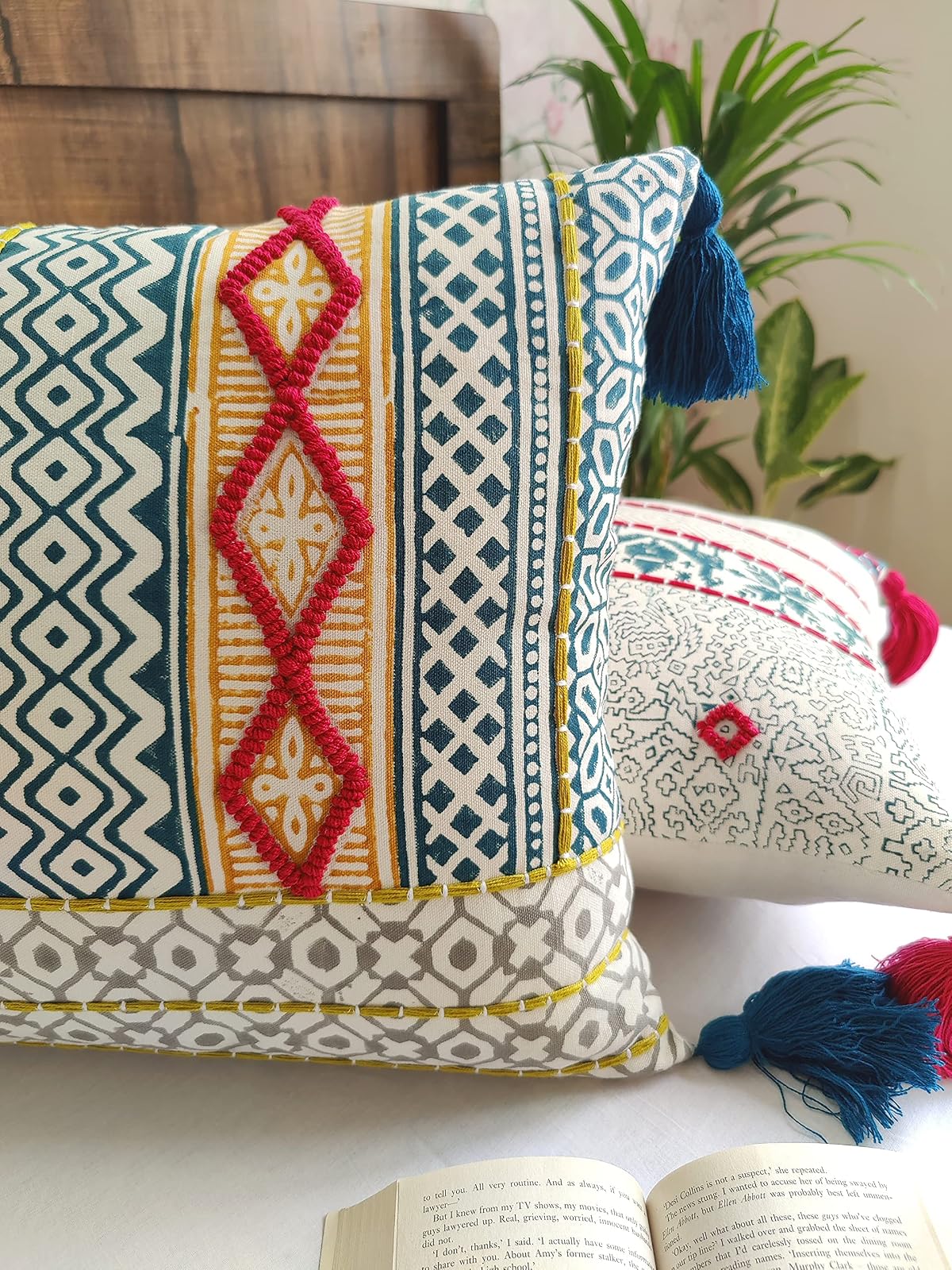
Hand block printing around Jaipur splits into two traditions with different looks: Sanganer, fine floral repeats printed on a white or pale ground, and Bagru, earthier work built on mud-resist dabu printing and natural dyes.
The process is exactly what the name says. A design is carved into a block of seasoned wood, usually sheesham or teak, one block per colour. The block is charged with dye and struck onto the cloth by hand, repeat after repeat, along the full length. A three-colour design means three blocks and three passes over every metre, aligned by eye against registration marks. A printer works quickly, but a bedsheet is still hours of standing at a table.
Sanganeri work is the fine version: dense floral and buti repeats, crisp outlines, printed on a light ground, historically for garments. Bagru is the rougher and older-feeling of the two, built around dabu, a mud and gum resist that is applied where the cloth should stay pale before it goes into the dye. Bagru palettes lean on what natural dyeing gives you: madder reds, iron blacks, indigo. The two are frequently sold interchangeably as Jaipur prints, which they are, but they do not look alike and it is worth knowing which you are buying.
Telling hand printing from a screen or digital print takes about ten seconds once you know what to look for. Hand printing shows its joins: the repeat will be very slightly out of true here and there, colour density varies across a length, and you can often see where one block impression meets the next. There will be small imperfections, a smudge, a skipped edge. A screen print is perfectly regular everywhere, and a digital print has photographic gradients no carved block can produce. On the reverse, hand block printing on light cotton usually penetrates the weave and is visible from the back; a surface print sits on top.
Those irregularities are the product, not a defect in it, and this is the single most common misunderstanding among first-time buyers. Cloth that is identical along its full length was printed by a machine. If perfect uniformity matters to you, hand block printing is the wrong purchase and there is no point being disappointed later.
Natural-dyed pieces bleed on the first wash and are meant to. Wash separately in cold water the first two or three times, skip the detergent early on, and dry out of direct sun, which fades vegetable dyes quickly. Expect some softening of the colour over the first year. Chemical-dyed block prints, which are the majority of what is sold, are far more stable and can be treated like ordinary cotton.
Cotton is the usual ground: plain cotton for bedsheets and dohars, mulmul for lighter layers, cotton silk for dupattas. What is genuinely worth importing is the yardage and household textiles, because American retail sells the aesthetic through interior brands at several times the price and rarely the real thing. What is not worth importing is a single cheap scarf, where freight can approach the item.
Questions people ask
- How do I know it is really hand block printed?
- Look for slight irregularity in the repeat, small variations in colour density, and visible joins between block impressions. On light cotton the print usually shows through to the reverse. Anything perfectly uniform along its whole length, or carrying photographic gradients, was machine printed.
- What is the difference between Sanganeri and Bagru?
- Sanganeri is the fine floral tradition printed on a pale ground. Bagru is built on dabu, a mud resist, and typically uses natural dyes, giving earthier madder reds, iron blacks and indigo. Both come from villages near Jaipur and both are sold as Jaipur block print.
- Will the colour run?
- Naturally dyed pieces will release some colour on the first few washes. Wash separately in cold water, without detergent at first, and dry away from direct sunlight. Chemically dyed block prints are stable and wash like ordinary cotton.
- Are the small flaws a defect?
- No. Uneven ink, a slight break in a repeat and a visible block join are evidence the cloth was printed by hand. Perfectly even printing is the sign of a machine.